
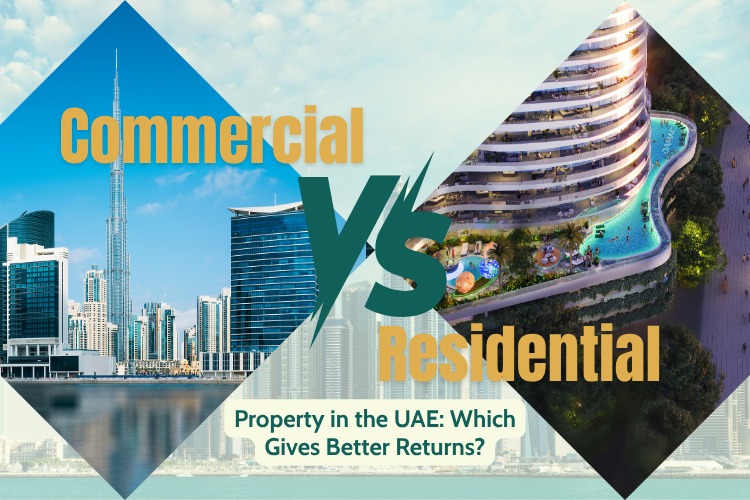
Commercial vs Residential Property in the UAE: Which Gives Better Returns
When it comes to real estate investment, few resolutions are as critical as selecting between commercial vs residential property in the UAE. The UAE property market is opening up to global investors but the potential of real estate investment returns in Dubai depend on understanding not only their benefits but also their risks.
In this blog, we unpack the differences between commercial and residential investments, compare their returns and risks, and help you decide the best property type to invest in the UAE for your goals. We’ll also explore the commercial property benefits in Dubai offers, as well as residential property investment in the UAE.
Understanding Commercial vs Residential property in the UAE
Residential Property Investment in Dubai
Residential properties refer to apartments, villas, townhouses and living spaces. The UAE market provides these assets with different advantages but also challenges attached to them.
Benefits:
Relatively low entry cost: Residential units are usually less expensive than commercial ones, and hence, super easy for new or moderate‐capital investors.
Stable rental demand: The increasing expat population and the demand for quality residential properties often lead to steady rentals for such properties.
Quick resale & liquidity: Residential estates have more buyers and less difficulty getting out of the investments.
Regulatory and tax benefits: For instance, profits from rentals are tax-exempt in several cases.
Challenges:
Low rental income: Residential properties yield lower returns compared to commercial ones.
More frequent tenant changes & shorter leases: Residential leases normally last a year or less, causing more tenant changes and management work.
Expenses: Net returns are often reduced by service charges, maintenance, utilities, and management.
Market-cycle sensitivity, oversupply, and demand: Due to oversupply in residential areas, rents or valuations may decrease.
Risks:
Vacancy or Non-payment Risk
Value Changes
Legal Adjustments
Dependence on Tourism/Expats
Unexpected Expenses
Commercial Property Investment in Dubai
There is a diverse range of commercial properties which consist of office units, retail shops, warehouses, industrial units and business‐use space. The dynamics of these properties are quite different from the residential ones.
Benefits
Higher potential returns: The rental yields for commercial properties are quite often higher than the corresponding ones for the residential.
Longer leases: Usually 3–5 years or even more, hence, providing more stable cash flow and less frequent tenant turnover.
Professional tenants & rental cost shift: Business tenants usually take care of the fit-outs, utilities or maintenance thus lessening the landlord’s burden.
Key business zones with strong growth potential: The UAE is diversifying its economy and consequently the demand for commercial space in various locations is on the rise.
Challenges
Higher entry cost and investment scale: Commercial units are more capital intensive than residential ones and often require complex financing.
Higher vacancy and liquidity risk: In the case of an economic downturn or if the tenant does not fit, the space may be vacant for a longer period; thus, the resale may take longer.
Economy and business-cycle dependency: It is more that the commercial properties are affected by the performance of the business and the world economy shift.
Complex regulations: Commercial properties often face difficulty in maintaining leasing and tenant’s business feasibility.
Risks
Market Volatility
Longer Vacancy Periods
High Maintenance & Service Costs
Tenant Risk
Liquidity Risk
Regulatory or Licensing Risks
Comparing Real estate investment returns in Dubai
Capital growth: Residential markets show stable appreciation, while commercial values can rise during economic upswings but dip during recessions.
Liquidity: Residential assets are generally easier to sell or rent; commercial properties often take longer due to niche demand.
ROI: Commercial properties promise higher rewards but also carry greater risk and complexity whereas residential ones offer steady, lower-risk growth in terms of real estate investment returns in Dubai
- Residential properties average 5 % – 8 % yields, depending on location and unit size.
- Commercial properties can offer 7 % – 12 %, especially in prime business districts or logistics hubs.
Best Property Type to Invest in the UAE:
Residential property investment in the UAE is often the safer, simpler choice. You’ll benefit from broader demand for housing, especially in good locations where as the commercial property benefits in Dubai offer long leases, professional tenants, high demand in business hubs could pay off significantly.
Key factors to consider before investing
- Location matters
- Tenant stability
- Management complexity
- Economic sensitivity
- Entry cost & liquidity
- Regulation & charges
CONCLUSION
Choosing between commercial vs residential property in the UAE is not a matter of “which is always better?” but rather “which is better for you?” If you prioritise higher returns, have adequate capital, and are comfortable navigating complexity, commercial property may be your path. If you prefer ease of entry, lower risk, and flexibility, residential property investment UAE could be the optimal starting point.
At Shubh Labh Realtors, we specialise in both sides of the market helping you evaluate real estate investment returns in Dubai, understand the market nuances of commercial property benefits in Dubai, and decide the best property type to invest in the UAE according to your portfolio goals.
“Shubh Labh Realtors: Guiding you to smart property returns, whether you live in it or lease it.”
FAQ’S
What kind of returns can I expect from residential property investment in the UAE?
Residential rental yields in the UAE typically range from about 5% to 8% depending on property type, location, and market conditions.
What about returns from commercial property in Dubai?
Commercial properties in Dubai often yield around 7% to 12% or even higher in prime locations.
Are there any special commercial property benefits in Dubai?
Yes. Long lease terms with professional tenants provide steady income; business demand in key locations is strong; there are also growth opportunities in areas like logistics/warehouses thanks to e-commerce.
Recent Posts
- Long-Term Leasing in Dubai: What Property Owners Should Know in 2026
- How Property Ownership in Dubai Helps Expats Settle Long-Term in 2026
- Furnished vs Unfurnished Properties in Dubai: What Makes More Sense in 2026?
- Is It Better to Buy Ready Property or Newly Launched Projects in Dubai in 2026?
- Golden Visa vs Normal Residency in Dubai: Which Is Better for Property Buyers in 2026?

At Shubh Labh Realtors, we specialize in Dubai property investment, offering trustworthy and growth-oriented opportunities for investors. By combining in-depth market insights with Vastu-compliant property principles, we create harmonious living and investment spaces that balance prosperity, functionality, and long-term value in Dubai’s real estate market.
Useful Link
Locations
- Citadel Tower - 1303, Level - 13 - Business Bay, Dubai - U.A.E Call: +971 55 442 5467 +971 52 938 1345
- SVINNINGEGRAND 23 163 61 Spanga Stockholm, Sweden Call: +46 70 738 34 39
- 24 Thirsk Road, London, England, SE25 6QG
- Samura, 2nd Floor, 3rd Cross Road, Lal Bagh Road, Sudhama Nagar, Bengaluru, Karnataka 560027 Call: +91 99726 04049
© 2026 Shubh Labh All Rights Reserved