

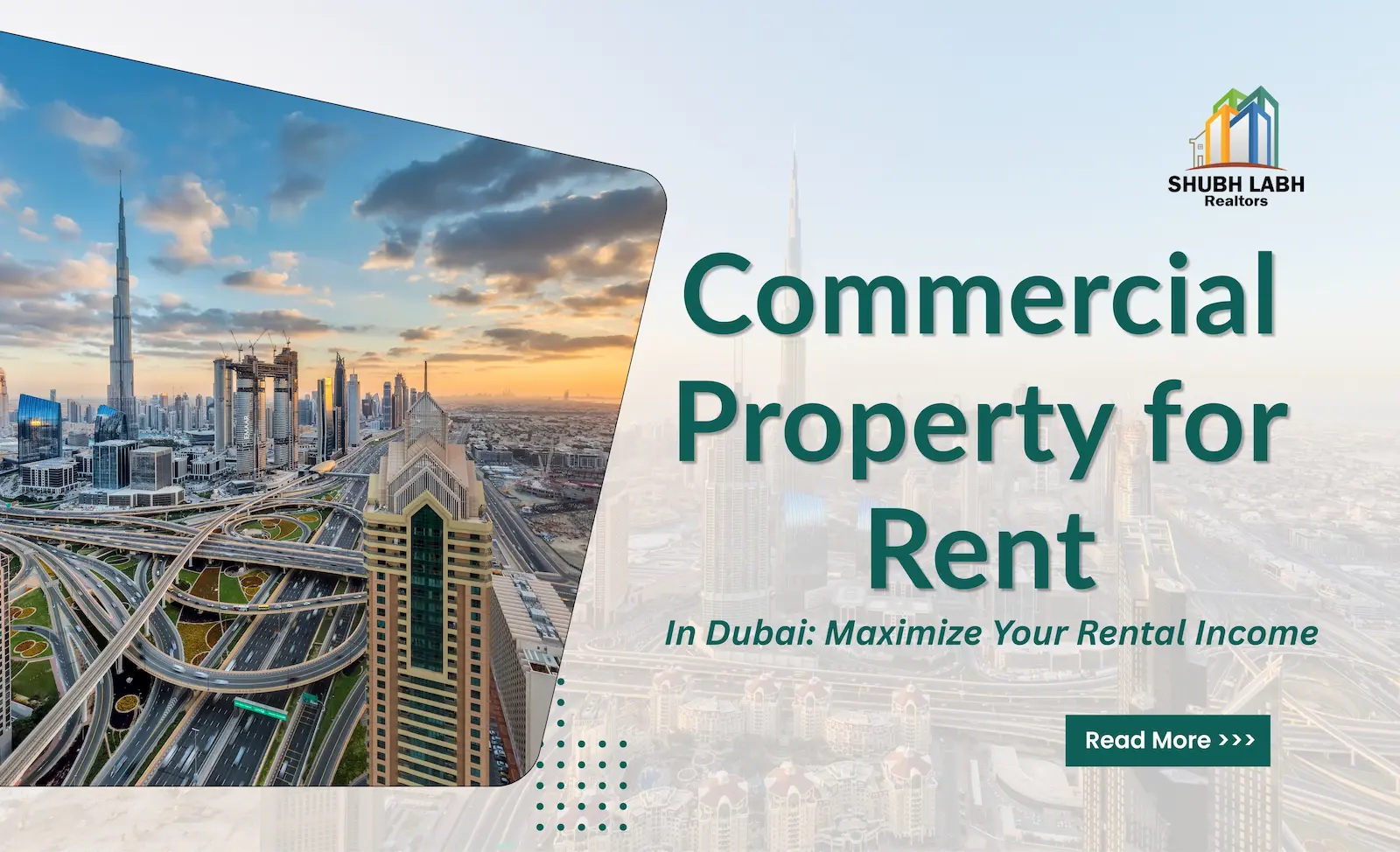
Commercial Property for Rent in Dubai: A Practical Guide to Rental Income
Dubai is one of the only markets where an Indian investor can buy property priced in a currency linked to the US dollar and receive income without paying personal income tax. But commercial property for rent in Dubai is not just one market — a climate-controlled warehouse in Dubai South, a fitted office in Business Bay and a retail shop in City Walk are on entirely different yield curves. The difference between a 6% yield and a 10% yield is almost entirely asset class, service charges and how well the lease was negotiated.
What Does Commercial Property for Rent in Dubai Include?
Commercial stock in Dubai ranges from shell-and-core in the DIFC to warehouses near Al Maktoum International Airport. Each property type has its own lease length, service-charge burden and tenant profile — so, which is the “best” property depends entirely on whether you need the regular income or simply the headline yield. One thing that Indian investors overlook: commercial rent in Dubai is subject to 5 per cent VAT.
How Is Commercial Property Different From Residential?
Commercial leases are also typically longer than in the residential market (three-to-ten years versus one-year tenancies). That gives yield certainty and greater escalation, but also longer voids post-vacating plus higher fit-out investment for new tenants. The tenant usually pays for the internal maintenance, and rent is payable up to once a quarter in one to four cheques rather than the 12 payments linked to residential properties. You are pricing the benefits of lower churn for a greater entry price.
Dubai Commercial Rental Yield: How Gross and Net Actually Work
Commercial property brokers in Dubai publish 6–9% gross figures, yet service charges in Dubai properties of AED 15–35 per sq ft per year (roughly ₹355–₹830) can eat away one or two percentage points just before you get the dirham. That gap alone makes the decision for most investors. For a broader benchmark, review these Dubai rental yield strategies for Indian investors.
What Is the Formula for Net Rental Yield?
- Gross yield: Divide annual rent by purchase price and multiply by 100. For example, a unit purchased for AED 2 million (approximately ₹4.74 crore) and rented at AED 160,000 (about ₹37.9 lakh) yields 8%.
- Deduct operating costs: Factor in service charge, district cooling, property management fees of 5–8% of rent, maintenance and loss of rent due to vacancy.
- Add acquisition costs to the denominator: Include the 4% Dubai Land Department transfer fee, agency commission and fit-out spend. Review the complete cost of owning property in Dubai so your model is realistic.
- Net yield: Divide net rent by total acquisition cost. Underwrite on this figure, not the brochure number. For a deeper evaluation, use a Dubai property investment analysis.
What Is the Most Profitable Type of Commercial Real Estate?
There is a big difference between profitable property investments and the “best” investments. The most productive commercial assets in Dubai typically carry the greatest operational risk. Prime offices have the lowest returns but the safest covenant.
Asset class | Typical gross yield | What drives it |
Prime office (DIFC, Downtown) | 6–8% | Long leases, blue-chip tenants |
Secondary office (Barsha Heights, JLT) | 7–9% | Lower entry price, higher churn |
Retail and F&B | 7–9% | Footfall, turnover-linked rent |
Warehouse and logistics | 8–11% | Long leases, low service charges |
Staff accommodation | 9–12% | High management intensity |
How Much Money Can You Make in Real Estate in Dubai?
For example, an AED 1 million (about ₹2.37 crore) strata warehouse let at AED 90,000 (about ₹21.3 lakh) a year generates a net yield of about 6.5–7% after 12,000-odd in service charges, 6% management and a void factor.
Conversely, an AED 5 million office floor under a five-year corporate lease returns less — generally 6% gross, as low as 5% net — but far more predictably. Note that UAE corporate tax at 9% can apply to business income over AED 375,000.
Best Commercial ROI Areas in Dubai
Location in commercial property is about matching your asset to the right tenant pool, not about prestige. For example, a district suitable for logistics would not be appropriate for a clinic. For a wider shortlist, compare Dubai neighbourhoods with high rental yield and appreciation potential.
District | Best-fit asset type |
DIFC, Downtown, Business Bay | Prime and mid-market offices |
Barsha Heights, JLT, Dubai Silicon Oasis | Smaller offices, start-ups |
City Walk, JBR mall periphery | Retail and F&B |
Al Quoz, DIP, Dubai Industrial City, JAFZA | Warehousing and industrial |
Dubai South | Logistics and Expo City-linked demand |
Sheikh Zayed Road, Deira | Showrooms |
Best Areas to Invest in Dubai 2026 and Beyond
Catalysts outperform current rents. Dubai South is anchored by Expo City and the Al Maktoum airport expansion, which support long-term logistics demand.
With easy Metro access and a rich corporate tenant base, Business Bay is the place to go, while JLT and Barsha Heights are where the value remains for small-office tenants. Monitor the pipeline — areas with high future handover volumes usually see Dubai property rent flatten out before increases.
Dubai Buy to Let: What It Means for an Indian Investor
NRI buy-to-let is well established, with Indian NRI property buyers among the most frequent. Commercial property can be purchased with a 50–60% loan-to-value mortgage, with rental income often set against mortgage payments.
You can obtain the Golden Visa through property investment with an AED 2 million (around ₹4.74 crore) or more purchase. Remember to calculate an additional 4% DLD fee, agency commission and 5% VAT payable on the rent.
Rental Income Property in Dubai — What Different Budgets Buy
Rental income property in Dubai comes in several budget bands:
- Less than AED 1 million (around ₹2.37 crore): Smaller office units, strata warehouse bays and staff accommodation offer entry yield, with a greater management burden.
- AED 1–3 million (approximately ₹2.37–7.1 crore): Furnished offices in Business Bay or JLT, small retail outlets and mid-size warehouses — the ideal size for a commercial investment beginner.
- AED 5 million and above (approximately ₹11.8 crore): Whole floors, warehouse portfolios and larger retail assets in higher-tier locations, where institutional tenants and longer leases are more likely.
Legal, Licensing and Lease Terms You Must Verify
Your trade licence specifies where you are allowed to lease — mainland entities may operate throughout Dubai, while free-zone companies are usually limited to premises within their designated zone. Landlords must apply the same diligence: they should check the tenant’s licence, assess covenant strength and review the permitted-use clause before finalising any lease agreement.
Is Ejari Registration Mandatory for Commercial Rent?
Yes. All tenancy contracts must be registered on Ejari, which is mandatory for visas, utility connections and licence renewals. The certificate will be the legal reference if any disputes arise; review Dubai tenancy laws to understand your rights and obligations. Before signing, landlords should verify service-charge statements, building insurance, owners’ association status and mortgage approvals.
Quick Glance Checklist for Commercial Property for Rent in Dubai
- Confirm the asset class and the tenant pool it appeals to.
- Model net yield, not gross — service charges and VAT make all the difference.
- Check district demand as well as future supply quantities; review the Dubai 2026 property outlook.
- Verify Ejari, permitted use and covenant strength.
- Budget 4% DLD, agency fee and fit-out; use a transaction management expert for paperwork.
- Simulate a three-month void period before making your commitment.
Commercial property for rent in Dubai rewards investors who underwrite properly, rather than those who chase headline numbers. Districts, asset classes and lease structures can be understood in advance — the difference between a 6% and a 10% return comes down to service charges, tenant quality and negotiation.
Shubh Labh Realtors works with Indian buyers in exactly this way: shortlisting commercial assets by net yield, verifying the paperwork and structuring long-term lease terms that remain robust over a five-year period.
FAQ’S
What is the best investment in Dubai in 2026?
For income, commercial properties — warehousing, mid-market offices and staff accommodation — tend to outperform residential on gross yield. Residential offers more liquidity and involves smaller units.
What counts as a good rental yield in Dubai?
Above 7% net is good for commercial property. Prime office tenants will often achieve 5–6% net, while industrial and staff accommodation can achieve 8–9% net after costs.
Can foreigners rent commercial property in Dubai?
Yes. Commercial space can be leased to individuals and foreign companies; companies with free-zone licences must lease within their free zone. For general leasing rules, see the guide to renting in Dubai as a foreigner.
Is commercial rent subject to VAT in Dubai?
Yes, 5% VAT applies to commercial rentals. It is not applicable to residential rent. Include this in your quotation and net yield.
Recent Posts
- Commercial Property for Rent in Dubai: A Practical Guide to Rental Income
- Dubai Commercial Property Trends: A Practical Guide for Investors and Occupiers
- Commercial Property Registration in Dubai: Process, Fees and Freehold Checklist
- Golden Visa vs Green Visa UAE 2026: Which Residency Route Is Linked to Property?
- Capital Appreciation vs Rental Income in Dubai: Which Investment Strategy Builds More Wealth?

At Shubh Labh Realtors, we specialize in Dubai property investment, offering trustworthy and growth-oriented opportunities for investors.
Useful Link
Get In Touch
Speak with our experts and unlock the right opportunities.
© 2026 Shubh Labh All Rights Reserved